Why a small WordPress theme shop is named after Greek gods — and why the naming turned out to be the most useful design decision I made.
I expected the names to be decoration. They became the thing that kept the work honest.
I have spent seven years building websites for a company. It is good work, and all of it is to somebody else’s brief.
I wanted to make something that was mine, and somewhere to put the part of the job a brief never has room for.
WordPress is where I went back to, which surprised me — I had rather assumed I was done with it. It turned out to be like running into a friend you had lost touch with: familiar, considerably changed, and far better company than I remembered.
The problem I kept running into
Most commercial WordPress themes are multipurpose.
One theme, forty demos, a slider, a page builder, a shop, a restaurant menu, an events calendar, a portfolio grid, and a settings panel with several hundred options to switch it all on and off.
They sell well, and I understand why. A buyer sees forty demos and thinks: whatever I need later, this covers it.
What actually happens later is that you use one demo, and carry the other thirty-nine forever. They are in the download, in the update, in the CSS your browser parses, in the settings panel you scroll past every time you want to change one colour. A theme that does everything is a theme that has never had to decide anything — and every decision it declined to make is now yours.
I did not want to build that. But the alternative — one theme that does one thing — is a hard business: too narrow to sell.
So: four themes. Each one allowed to specialise hard, sharing a foundation so I only build the foundation once.
Which left me naming four things
Four names that had to be distinct, memorable, pronounceable, and — this is the part I underestimated — had to mean something specific enough to argue with.
Greek gods have one property that made them right: each is the god of something. Not a mood or a colour, a domain. And once a theme is named for a domain, the domain starts answering questions about the theme.
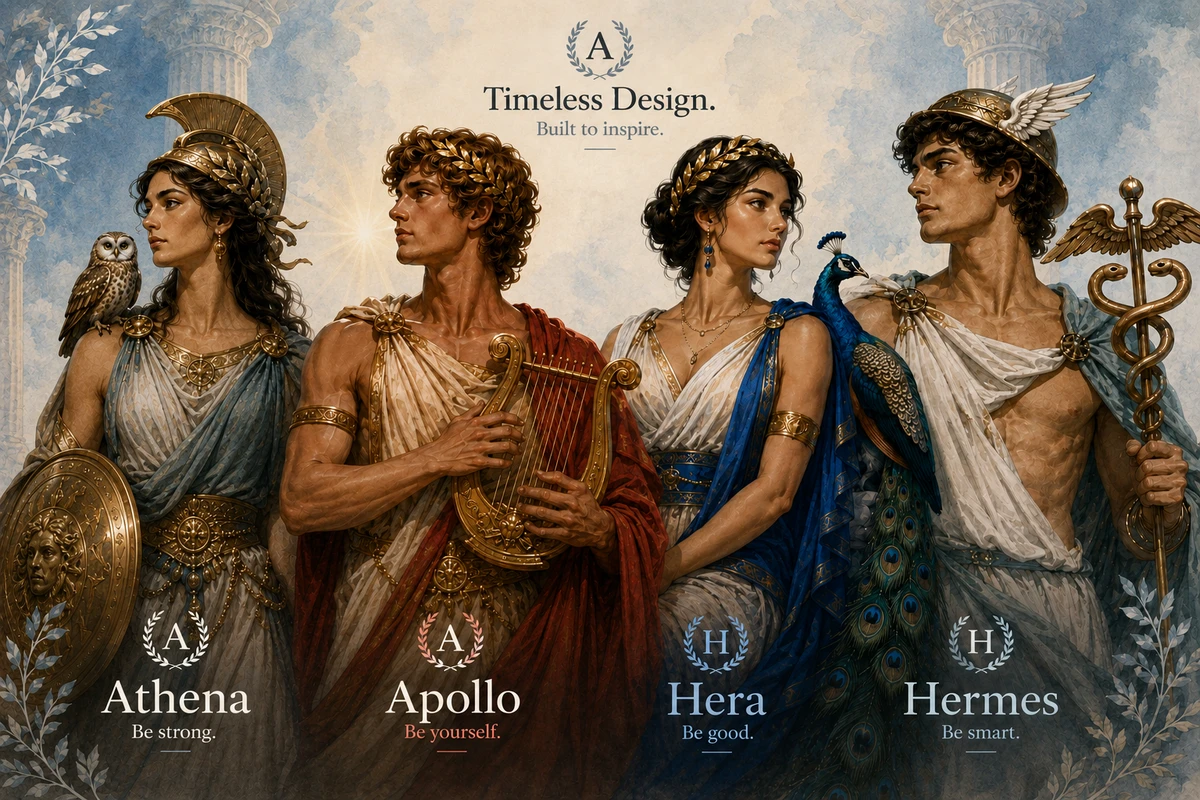
Athena — craft, strategy, the patron of people who make things carefully. Editorial and portfolio work. Be strong.
Apollo — music, poetry, light. Musicians, bands, podcasters. Discography, tour dates, episodes, streaming links. Be yourself.
Hera — sovereignty, the institution, the established order. Consultancies, agencies, companies that need to look like they will still exist next year. Be good.
Hermes — commerce, roads, messengers, and — the myths are honest about this — merchants and thieves. The shop. Product templates, cart, checkout. Be smart.
Hermes was the one that convinced me the scheme was right rather than cute. He is not associated with trade; he is the god of it. When the naming and the job line up that exactly, it stops being a label.
And a mountain
The four themes are sold from a fifth theme, which is not for sale. It is called Olympe — Olympus, the mountain the gods live on.
It exists only to sell the other four. It has one client, ever: me. And that turns out to matter, because it means Olympe can be opinionated in ways a sold theme cannot. It ships no photographs — every texture in it is a CSS gradient or inline SVG. It makes choices a buyer would want to override, and no buyer ever has to.
Naming it for the mountain rather than a fifth god was the point at which the scheme stopped being four names and became a structure.
What the names actually did
Here is the useful part, and the reason I am writing this rather than a post about fonts.
Every theme accumulates feature requests — mine, mostly, at two in the morning. Athena could have tour dates. Hera could have a discography. Any of them could have a shop.
The names give me a question that answers itself: whose is this?
Tour dates are Apollo’s. Not because Athena couldn’t display them, but because a theme for writers and studios that also does tour dates has started the slide into being a multipurpose theme with a smaller demo count. A shop is Hermes’. Pricing tables and logo walls are Hera’s.
It is a scope constraint wearing a costume. I did not design it that way. I noticed it working about three months in, when I caught myself not building something because it belonged to a different god.
The foundation stays shared — block templates, the typography library, the section styles, the colour system. Nineteen font pairings and four palettes in each. What specialises is what sits on top.
What follows from all of it
A few things I decided once and have not revisited:
Block themes, not page builders. Everything is a block template, a template part or a pattern. What you edit in the Site Editor is what ships. No proprietary layer that stops working the day you switch theme.
Fonts are local. Every family is in the theme folder — around thirty families and a hundred and thirty files per theme. Nothing is fetched from a font CDN, which means no visitor’s IP address goes to a third party to render your headings. That started as a performance decision and turned into a privacy one.
No theme requires a plugin, except the one that must. Hermes needs WooCommerce, because it is a shop. Nothing else in the family requires anything. The contact and newsletter sections leave a slot for whatever form plugin you already use.
Everything is translatable. Every user-visible string, including the ones hiding inside block attributes, which is harder than it sounds and is a post of its own.
Where this is going
There will be more themes. The list is long — what is short is the number that earn a place on it, because each has to do a job the other four do not.
And if one of these is nearly right for you and not quite, I would rather hear from you than have you fight the theme. Custom work is what I came from and I am not trying to leave it behind; a theme is simply the version of it that works when a bespoke build does not.
What I want is unglamorous and specific: to keep working in WordPress, and to build things for people who will actually use them.
The demos are live, one per theme, each running the real thing rather than a screenshot. Most of what I write here will be something that cost me an afternoon first — the undocumented corner of WordPress that ate a morning, written down so it eats less of yours.
Start with whichever god does your job.